Chem lab instruments for safer and more reliable testing

What chem lab instruments include
Chem lab instruments are not limited to devices that generate readings. A reliable chemical laboratory depends on a connected system of measurement tools, preparation equipment, containment devices, safety stations, storage controls, and records. A balance, pH meter, centrifuge, hot plate, fume hood, eyewash station, and waste container serve different purposes, but each one can affect whether chemical work is safe, repeatable, and defensible.
For laboratories planning upgrades or reviewing daily operations, the practical question is not only “which instrument should we buy?” It is “which instrument controls the risk or uncertainty in this workflow?” That approach is more useful than building a list from catalog names alone. Readers can also follow related updates in the lab instruments category.

Build the instrument list around the workflow
A chemistry laboratory normally uses instruments across five overlapping tasks: weighing and measuring, preparing samples, controlling reactions, separating or identifying materials, and protecting people from chemical exposure. The same instrument can also have more than one role. A heating mantle supports reaction control and may reduce some open-flame hazards. A fume hood supports containment, but it can also influence how equipment is arranged and how waste is staged during active work.
A workflow-based instrument list usually starts with the method. What mass range must be weighed? What temperature must be held? Does the sample release vapors? Does the method involve trace-level analysis, corrosive chemicals, flammable solvents, pressure, biological material, or regulated waste? Each answer can change the instrument specification.
Measurement and observation instruments
Common chem lab instruments in this group include analytical balances, top-loading balances, pH meters, conductivity meters, thermometers, data loggers, spectrophotometers, titrators, chromatographs, and microscopes. These tools produce or support reported results, so the main selection points are accuracy, resolution, calibration status, environmental limits, sample compatibility, and data handling.
Preparation and reaction support
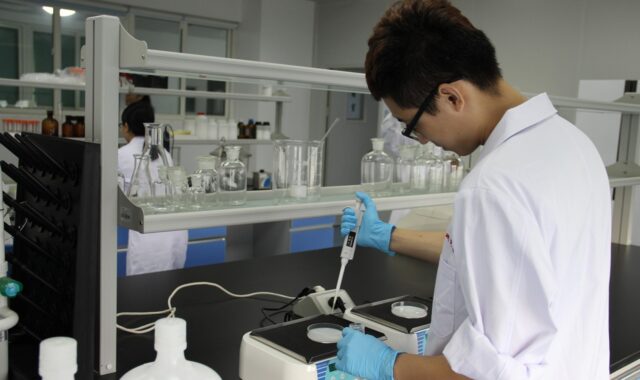
This group includes glassware, pipettes, dispensers, stirrers, hot plates, heating mantles, ovens, water baths, chillers, sonicators, vacuum pumps, desiccators, and centrifuges. Here, the selection focus shifts toward capacity, material compatibility, temperature or speed control, containment of aerosols or vapors, and safe shutdown features.
Containment and emergency equipment
Fume hoods, safety cabinets, spill kits, eyewash stations, safety showers, fire extinguishers, waste containers, secondary containment trays, and ventilation alarms are often treated separately from “instruments.” In practice, they are part of the same operating system. If a method cannot be performed safely without them, they belong in the instrument planning discussion.
Safety equipment is not optional background equipment
Several widely used references make clear that chemical work requires more than bench instruments. OSHA’s Laboratory Standard, 29 CFR 1910.1450, requires laboratories covered by the rule to have a Chemical Hygiene Plan. That plan must address equipment, personal protective equipment, work practices, and protective devices such as fume hoods. OSHA’s non-mandatory Appendix A, based on National Research Council recommendations, also treats regular inspection and maintenance of laboratory equipment as part of chemical hygiene.
The implication for instrument planning is straightforward: a new reaction setup, solvent workflow, or sample preparation method should trigger a safety equipment review. A laboratory should check whether ventilation is adequate, whether the fume hood is functioning as intended, whether incompatible chemicals are segregated, whether emergency drenching or flushing equipment is appropriate for corrosive exposure, and whether users can reach shutoffs, alarms, and spill controls quickly.
NFPA 45, the standard on fire protection for laboratories using chemicals, is another important reference for laboratories that handle flammable or reactive chemicals. It addresses fire protection, laboratory ventilation, chemical fume hoods, and related inspection and maintenance topics. Exact requirements depend on jurisdiction, facility type, chemical quantities, and local authority interpretation, so laboratories should not rely on generic internet checklists as a substitute for a qualified safety review.
Fume hoods deserve particular attention because their role is often misunderstood. A chemical fume hood is primarily an engineering control for hazardous vapors, gases, and aerosols, not a storage cabinet or a general-purpose enclosure. Crowding the hood with containers, blocking baffles, or placing large equipment in poor positions can weaken containment. Good practice is to verify hood performance, keep only necessary materials inside during active work, and maintain a written inspection or service history.
Measurement quality depends on calibration and fit for purpose
For laboratories that report analytical results, the most expensive instrument is not automatically the most suitable one. Measurement quality depends on whether the instrument is fit for the method, maintained within its operating limits, calibrated when needed, and used by trained personnel. ISO/IEC 17025:2017, the international standard for testing and calibration laboratories, places strong emphasis on equipment control, metrological traceability, and the competence needed to produce valid results.
Metrological traceability means that a measurement result can be related to a reference through a documented chain of calibrations, with each step contributing measurement uncertainty. NIST guidance on traceability explains that calibration records should include measured values, associated uncertainties, and a statement that supports the traceability chain. In a working chemistry lab, this affects balances, thermometers, pipettes, reference weights, volumetric devices, pressure gauges, and analytical instruments that influence reported data.
Calibration is not the same as adjustment, and neither is the same as daily verification. A balance may have an annual calibration by a qualified provider, while the lab still performs routine checks with appropriate weights before use. A pH meter may be calibrated with buffers at the start of work, but electrode condition, temperature compensation, and sample matrix can still affect accuracy. A pipette may have a calibration certificate, yet technique, liquid viscosity, and tip fit can change delivered volume.
The practical lesson is to document how each instrument affects the final result. Instruments used only for rough preparation may need different controls from instruments that directly generate reportable values. The control level should match the risk of a wrong result.
A practical selection matrix for common chem lab instruments
The following matrix organizes common instrument families by purpose rather than by catalog category. It is intended as a planning aid, not a substitute for site-specific safety, quality, or regulatory review. See also: buying guides.
| Instrument family | Primary use | Selection checks | Records to maintain |
|---|---|---|---|
| Balances and weighing systems | Mass measurement for reagents, samples, and standards | Capacity, readability, repeatability, draft protection, vibration control, calibration needs | Calibration certificate, routine check logs, cleaning records, service history |
| pH and electrochemical meters | Acidity, conductivity, ion-selective, or oxidation-reduction measurements | Electrode compatibility, temperature compensation, range, buffer availability, sample matrix | Calibration logs, buffer lot records, electrode maintenance notes |
| Heating and cooling equipment | Temperature control during preparation, reaction, or storage | Temperature range, uniformity, over-temperature protection, chemical compatibility | Temperature verification, maintenance records, incident or deviation logs |
| Centrifuges and separation tools | Phase separation, precipitation, or sample clarification | Rotor rating, imbalance detection, tube compatibility, aerosol control, speed verification | Rotor inspection, cleaning logs, speed checks, service reports |
| Fume hoods and local exhaust | Control of hazardous vapors, gases, and airborne contaminants | Face velocity or containment test method, sash function, alarm status, equipment placement | Inspection reports, performance checks, repair records, user training notes |
| Emergency and spill equipment | Immediate response to exposure, spill, or fire events | Location, accessibility, chemical compatibility, inspection frequency, user training | Inspection tags, drill records, replacement logs, corrective actions |
| Waste handling equipment | Collection and segregation of chemical waste | Container compatibility, closure, labeling, secondary containment, segregation of incompatibles | Waste labels, pickup records, inspection logs, disposal documentation |
Maintenance and records should be planned before purchase
Many instrument problems begin before the instrument is installed. A laboratory may buy a device that needs more bench space, ventilation, power quality, water supply, drain capacity, software control, or service support than the room can provide. Installation requirements should be reviewed before procurement, especially for fume hoods, chromatographs, ovens, vacuum systems, compressed gas systems, and instruments connected to building utilities.
Maintenance planning should answer four questions. First, which parts need routine cleaning, replacement, or inspection? Second, which performance checks can trained users perform, and which require outside service? Third, which records are needed for safety, quality, or regulatory purposes? Fourth, what is the fallback plan if the instrument is unavailable?
Records do not need to be complicated, but they should be consistent. A useful record usually identifies the instrument, the date, the person performing the check, the acceptance criteria, the result, and any corrective action. In regulated or accredited environments, record control may require additional review, retention, and authorization steps.
Lifecycle decisions should also include consumables and disposal. Pipette tips, filters, lamps, electrodes, reference materials, columns, tubing, seals, batteries, and sensors can affect both cost and performance. EPA hazardous waste guidance emphasizes that waste containers and labels must be managed correctly under applicable generator rules. Because waste obligations vary by institution, generator category, state rules, and waste type, laboratories should confirm local requirements rather than relying only on a generic equipment list.
How to evaluate an instrument upgrade
An upgrade should be justified by a defined limitation. Useful reasons include improved safety, better measurement uncertainty, reduced sample loss, higher throughput, better traceability, easier cleaning, lower exposure potential, improved data integrity, or replacement of unsupported equipment. Weak reasons include vague modernization, appearance, or buying a feature that the method does not require.
Before approving a purchase, compare the current pain point with the proposed improvement. If a balance is unstable because of drafts and vibration, a new model may help, but so may better placement, an anti-vibration table, or a draft shield. If a pH meter gives inconsistent readings, the issue may be electrode condition, buffer handling, temperature, sample matrix, or user technique rather than the meter body. If fume hood work feels difficult, the answer may involve hood testing, sash discipline, workflow layout, or chemical substitution.
The strongest upgrade cases connect the instrument to measurable outcomes. Examples include reducing repeated sample preparation, meeting a method detection limit, improving temperature stability, documenting calibration traceability, lowering manual handling of corrosives, or replacing equipment that can no longer be serviced. That evidence-based approach is more useful than treating chem lab instruments as isolated purchases.
Frequently asked questions
What are the most common chem lab instruments?
Common chem lab instruments include balances, pH meters, pipettes, glassware, hot plates, stirrers, centrifuges, ovens, water baths, spectrophotometers, chromatographs, fume hoods, safety showers, eyewash stations, and chemical storage or waste containers. The right list depends on the method, hazards, sample type, and quality requirements.
Is a fume hood considered a lab instrument?
In many purchasing lists, a fume hood is treated as facility equipment. In practical laboratory planning, it should be considered part of the instrument system because it directly affects whether chemical work can be performed safely. Its performance, inspection history, and user practices matter as much as the bench instruments placed inside it.
How often should chem lab instruments be calibrated?
There is no single interval that fits every instrument. Calibration frequency should be based on manufacturer recommendations, method requirements, risk of drift, usage intensity, historical performance, and any regulatory or accreditation requirements. Instruments that directly affect reported results generally need stronger controls than tools used only for rough preparation.
What is the difference between calibration and verification?
Calibration establishes the relationship between an instrument reading and a reference standard, often with documented uncertainty. Verification checks whether the instrument is performing within defined acceptance limits for a specific use. A laboratory may need both, depending on the instrument and the method.
What should a lab review before buying new chemical laboratory equipment?
Before purchase, review the method requirements, chemical hazards, utility needs, installation space, ventilation, calibration requirements, maintenance support, consumable cost, data handling, waste implications, and user training. The best choice is the instrument that fits the workflow and controls the most important risks, not necessarily the model with the longest feature list.